

Digital marketing is one of the few fields where the rules can change overnight.
An algorithm update rolls out. A new ad format appears. A platform loses relevance while another explodes in popularity. What worked six months ago — sometimes even last month — suddenly doesn’t.
This constant evolution raises a common and fair question:
Is a college degree in digital marketing more valuable than real, hands-on experience?
The honest answer isn’t black and white. A degree has value. Experience has value. But they prepare people for the industry in very different ways.
What a Digital Marketing Degree Does Well
A college degree in digital marketing isn’t useless — far from it.
In fact, formal education often provides:
- A strong foundation in marketing principles
- Exposure to consumer psychology and branding theory
- An understanding of analytics, strategy, and business frameworks
- Practice with collaboration, deadlines, and presentations
These fundamentals matter. Knowing why marketing works is just as important as knowing how to execute it.
For many people, a degree also creates structure. It introduces terminology, processes, and strategic thinking that can take years to piece together on your own.
Where a degree shines most is in teaching how to think, not necessarily how to execute in real time.
Where Degrees Often Fall Short in Digital Marketing
Digital marketing doesn’t stand still — and that’s where traditional education can struggle to keep up.
University curriculums move slowly. Google, Meta, TikTok, and email platforms do not.
A student might graduate having learned:
- SEO best practices that are already outdated
- Ad strategies based on old targeting models
- Social media tactics that no longer align with current algorithms
Google alone can roll out multiple significant updates in a single year. Each update forces marketers to reassess:
- What content ranks
- How authority is measured
- Which tactics are now risky or ineffective
This means even experienced marketers are constantly relearning the game.
A degree earned four years ago — without continued hands-on work — can quickly lose practical relevance.
The Reality of Hands-On Digital Marketing Experience
Hands-on experience lives where theory meets consequences.
When you work day to day in digital marketing, you:
- Watch rankings drop after an algorithm update
- See ad costs spike without warning
- Test messaging that fails — and learn why
- Adapt strategies under real budget and timeline pressure
Experience forces problem-solving in real environments, with real stakes.
Someone actively managing campaigns is learning continuously:
- What Google rewards right now
- How strategies behave across different industries
- How audiences actually respond, not how textbooks predict they should
That kind of knowledge can’t be fully taught in a classroom.
Why the Industry Is Always Relearning the Rules
Digital marketing is uniquely unstable compared to many professions.
Doctors don’t relearn anatomy every year. Accountants don’t wake up to new math.
Marketers, however, must constantly adjust to:
- Algorithm updates
- Privacy changes and tracking limitations
- New ad placements and formats
- Shifting user behavior and attention spans
Even Google’s own guidance evolves.
Tactics that were once “best practice” can become liabilities overnight. This makes adaptability more valuable than static credentials.
The most effective marketers aren’t the ones who learned something once; they’re the ones who keep learning.
No Degree Doesn’t Mean No Expertise
One of the biggest misconceptions in digital marketing is equating degrees with competence.
In reality:
- Some degree-holders struggle to execute
- Some non-degree marketers outperform entire teams
A lack of formal education does not mean a lack of skill, intelligence, or strategic thinking.
Many highly successful marketers are self-taught, agency-trained, or grew through hands-on roles. They’ve built expertise by:
- Testing relentlessly
- Studying platform changes
- Analyzing real data
- Learning from failures
Experience compounds quickly in this industry.
Someone with five years of active campaign management may be far more valuable than someone with a degree but little real-world exposure.
Degrees vs Experience When It Comes to Salary
One of the clearest ways to see how the industry values performance over credentials is by looking at salary data.
According to Salary.com data for Digital Marketing Manager roles, compensation is driven far more by role impact than by how someone entered the field. In fact, the data shows something surprising:
- A candidate with no experience and a bachelor’s degree
- A candidate with 20 years of hands-on experience and no degree
can fall into the same salary range. but it does mean degrees aren’t the sole, or even primary, indicator of value.
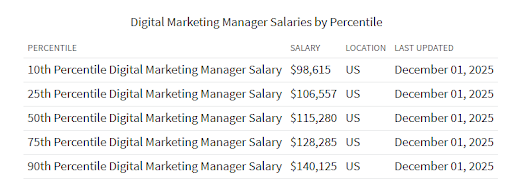
Together, these visuals reinforce a critical industry truth: formal education alone does not guarantee higher pay, and lack of a degree does not cap earning potential.
What ultimately matters is the ability to deliver results, adapt to platform changes, and drive measurable growth.
Salary in digital marketing is often tied to impact, not credentials.
Companies ultimately care about:
- Can you drive traffic?
- Can you convert leads?
- Can you scale revenue profitably?
If someone without a degree can consistently produce results, they are just as worthy; if not more worthy, of a higher salary.
Results-based industries reward performance.
That doesn’t diminish the value of education, but it does mean degrees aren’t the sole; or even primary, indicator of value.
The Most Competitive Marketers Blend Both
The strongest digital marketers usually combine:
- Foundational knowledge (often from education)
- Continuous hands-on experience
- Ongoing self-education and testing
A degree can open doors. Experience keeps them open.
In an industry shaped by constant change, adaptability, curiosity, and execution matter just as much — if not more — than formal credentials.
What Actually Matters Long-Term
Digital marketing doesn’t reward complacency.
Whether you have a degree or not, success comes down to:
- Staying current
- Learning continuously
- Adapting quickly
- Proving results
A college degree can be valuable — but it’s not a guarantee of success.
And not having one doesn’t disqualify anyone from being highly skilled, highly paid, or highly respected in the field.
In a world where Google changes the rules regularly, the real advantage belongs to those willing to keep learning again and again.