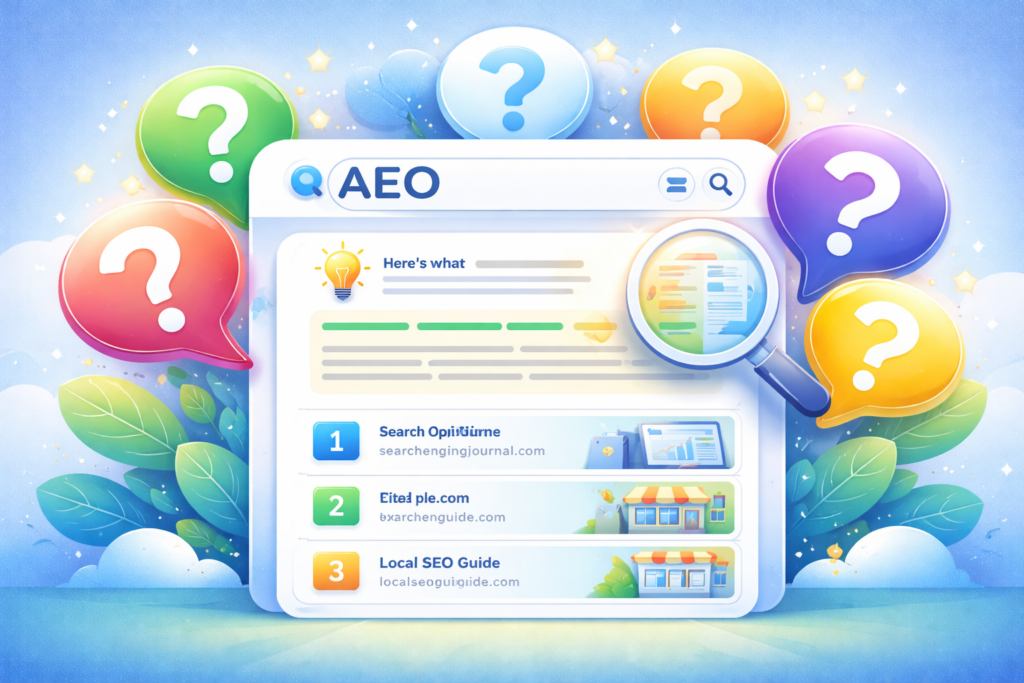
Another acronym has entered the digital marketing conversation: AEO.
It stands for: Answer Engine Optimization.
And just like GEO, it’s being framed as something revolutionary. A complete shift. A brand-new strategy that replaces everything we’ve done in SEO for the last decade…. IT ISN’T!

AEO is not a rejection of traditional SEO. It’s an evolution of it. The difference is not in the fundamentals — it’s in the format of the results.
Let’s break down what AEO really means and why, if you’ve been doing strong SEO, you’re already aligned with it.
What Is AEO?
Answer Engine Optimization focuses on optimizing content so that search engines and AI systems can extract direct answers from your content and surface them in:
- AI Overviews
- Featured snippets
- Voice search responses
- Generative summaries
- People Also Ask boxes
Instead of optimizing only for ranking positions, AEO optimizes for being selected as the answer.
But here’s the key point: the signals that make content eligible for answer selection are largely the same signals that have powered SEO for years.
Why Does AEO Feel Like a Major Shift?
Search interfaces are changing.
Users now see summarized responses at the top of results. They ask conversational questions. They expect immediate clarity instead of scanning ten blue links.
That makes it feel like SEO must change completely.
In reality, the format changed more than the foundation did.
Answer engines still rely on:
- Crawlable content
- Clear structure
- Logical page hierarchy
- Strong internal linking
- Demonstrated authority
- Clean technical SEO
If your website is technically sound and your content is clear, structured, and authoritative, you are already positioned for AEO.
How Does Traditional SEO Align With AEO?
Let’s look at what traditional SEO has always emphasized — and how it directly supports AEO visibility.
Clear Content Structure
SEO has long recommended:
- Descriptive H1, H2, and H3 tags
- Short, direct paragraphs
- Bullet points for clarity
- Question-and-answer formatting
Why? Because structured content helps search engines understand context.
Answer engines thrive on structure. When your content clearly defines a question and then provides a concise, direct answer, it becomes easier to extract.
Well-structured content isn’t new. It’s just more valuable now.
Featured Snippet Optimization
For years, SEOs have optimized for featured snippets by:
- Answering specific questions directly
- Using definition-style paragraphs
- Including concise summaries
Featured snippets were the early version of AEO.
If you’ve ever optimized content for “position zero,” you were already doing AEO before it had a name.
Schema and Structured Data
Schema markup has been a best practice for over a decade. FAQ schema, HowTo schema, and structured data help search engines interpret context.
Answer engines depend on clear signals. Schema reinforces meaning and increases the likelihood that content is used in enhanced results.
AEO doesn’t replace structured data. It depends on it.
Topical Authority
Traditional SEO rewards depth.
If your website covers a topic comprehensively, interlinks related pages, and demonstrates expertise, you build topical authority.
Answer engines prefer authoritative sources because they aim to deliver trustworthy responses. Thin, scattered content is less likely to be selected.
Topical depth is not new. It has always been a ranking factor.
Technical Crawlability
None of this matters if your site cannot be crawled or rendered properly.
Technical SEO still powers everything:
- Clean URL structure
- Fast load times
- Mobile optimization
- Proper canonicalization
- Logical internal linking
Answer engines pull from indexed content. If your technical foundation is weak, you reduce your chances of inclusion.
AEO still starts with technical SEO.
What Actually Changes With AEO?
The biggest shift is intent alignment.
Users are asking more conversational, specific, long-form questions. That means your content should:
- Match natural language queries
- Provide clear, immediate answers
- Avoid fluff before the explanation
- Include supporting depth after the answer
AEO rewards clarity first, depth second.
Traditional SEO sometimes encouraged long introductions for keyword context. With answer-focused content, clarity must come sooner.
But even that isn’t a dramatic departure — it’s a refinement of good content writing.
What Should Businesses Focus On?
Instead of chasing AEO as if it’s a separate strategy, strengthen the fundamentals.
Write Clear Definitions
When introducing a topic, include a concise explanation early in the content. Direct definition paragraphs increase answer eligibility.
Use Question-Based Headings
Structure sections as real questions when appropriate. This aligns with conversational search behavior and improves extractability.
Keep Answers Direct
Avoid burying your main point in five paragraphs of background. Lead with clarity.
Build Depth Around Core Topics
Create clusters of related content that support your main services or expertise areas. Authority increases answer selection probability.
Maintain Technical Excellence
Fast, mobile-friendly, cleanly structured sites perform better in both traditional search and AI-driven answer environments.
The Reality: Is AEO Just SEO With Better Formatting?
AEO isn’t a new marketing channel. It’s a presentation layer shift.
Search engines and AI systems still need:
- Reliable sources
- Structured content
- Clear signals
- Authoritative domains
If you’ve built a strong SEO foundation, you are not behind.
The businesses that will struggle are those who ignored technical SEO, thin content, and structure for years.
The businesses that invested in clarity, authority, and technical health are already aligned with AEO — whether they realized it or not.
FAQs
What does AEO stand for?
AEO stands for Answer Engine Optimization, which focuses on optimizing content to be selected as a direct answer in AI-driven and enhanced search results.
Is AEO different from SEO?
AEO builds on traditional SEO foundations. It prioritizes answer clarity and structure but relies on the same technical and authority signals.
Do I need a new strategy for AEO?
Most businesses do not need a completely new strategy. Strengthening technical SEO, content clarity, and topical authority supports both SEO and AEO.
Does schema help with AEO?
Yes. Structured data improves clarity for search engines and increases the likelihood of enhanced results.
Is AEO replacing SEO?
No. AEO is an evolution of SEO in response to changing search interfaces, not a replacement.